ONE-PAGE OVERVIEW · PDF
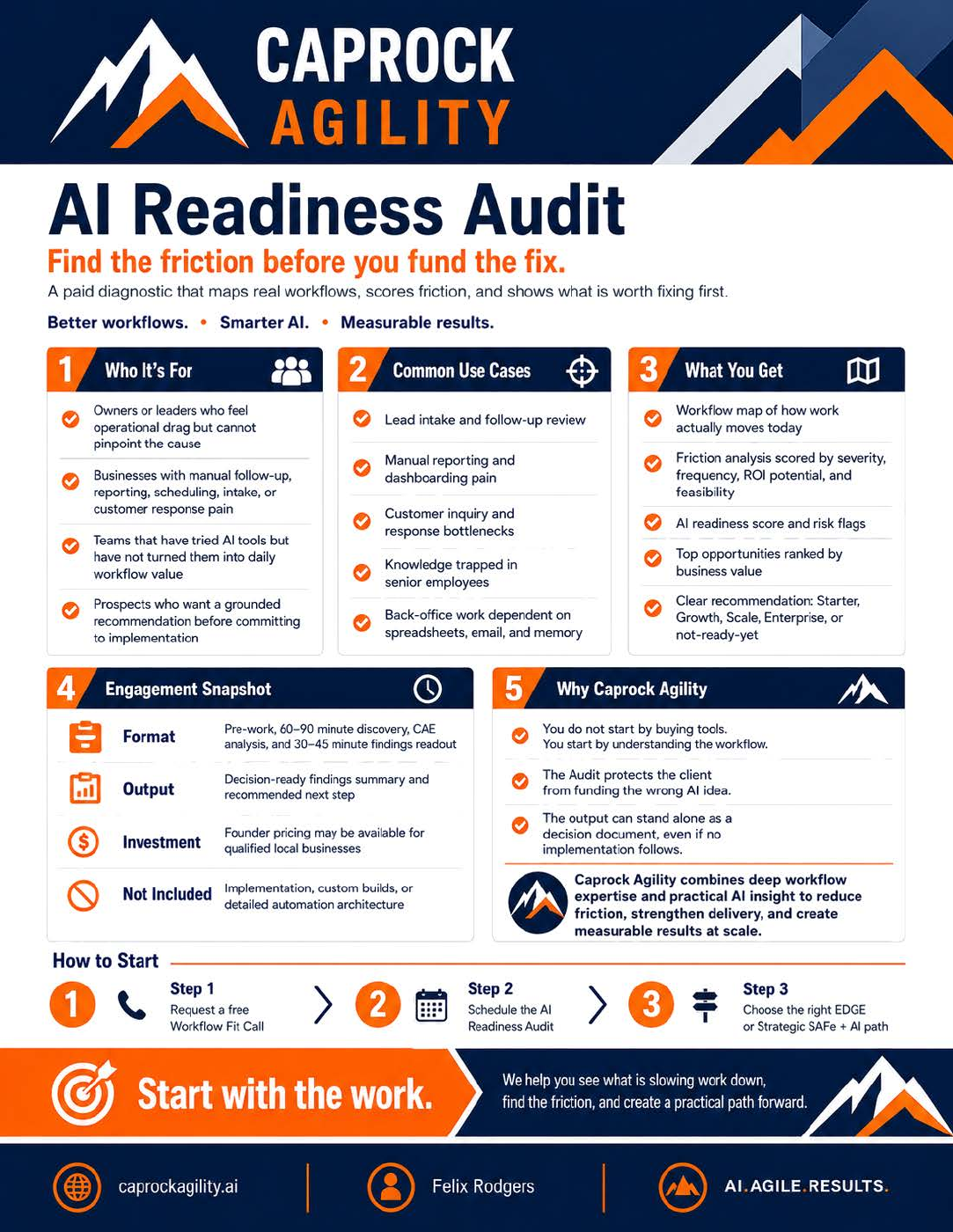
AI Readiness Audit, at a glance
Who it’s for, what’s included, engagement scope, and how to get started.
 CaprockAgility
THE CAPROCK SERVICE GUIDE
Watch how each engagement works. Explore the scope, the outcomes, and the details you can take with you.
The film could not load. You can open or download it below.
Read the key points below for the story at your own pace.
01 / CLARITY FIRST
A clear first move, grounded in how your business actually works.
For owners who feel the drag of slow follow-up, manual reporting, or disconnected tools—and want to know what is worth fixing first.
You can feel operational drag, but competing problems make it hard to choose where to start.
A decision-ready findings summary. Use it to choose an implementation path, resolve readiness gaps, or decide to wait.
The Audit starts with preparation and a 60–90 minute discovery conversation. Caprock maps the current workflow, identifies handoffs and bottlenecks, and examines how the tools, data, and people support the work.
Friction is scored by severity, frequency, potential value, and feasibility. You receive an AI readiness view, risk flags, and a ranked set of opportunities, discussed in a 30–45 minute findings readout.
The diagnostic can stand on its own. Implementation, custom builds, and detailed automation architecture are separate from the Audit.
Who it’s for, what’s included, engagement scope, and how to get started.
The film could not load. You can open or download it below.
Read the key points below for the story at your own pace. Time-saving figures in this film are illustrative estimates; your baseline and outcomes are measured during the engagement.
02 / ONE IMPORTANT WIN
A focused improvement your team can put to work.
Choose one recurring bottleneck and take it through a complete delivery cycle—from diagnosis and baseline to deployment, training, and review.
One repetitive process consumes time every week, and you have a clear owner ready to improve it.
One working improvement with an owner, a repeatable way to use it, and evidence to guide the next decision.
Many workflow problems show up as slow lead follow-up, repetitive customer replies, knowledge trapped in a few people, or manual reporting. Starter focuses the engagement on one well-chosen use case.
The delivery cycle covers diagnosis, baseline measurement, design, build, testing, training, an SOP handoff, and a Day 30 review. The goal is adoption in daily work, supported by a process the team understands.
The film illustrates lead follow-up, draft responses, a staff knowledge base, and automated reporting. Potential time savings depend on the volume of work, the current process, and how consistently the solution is used.
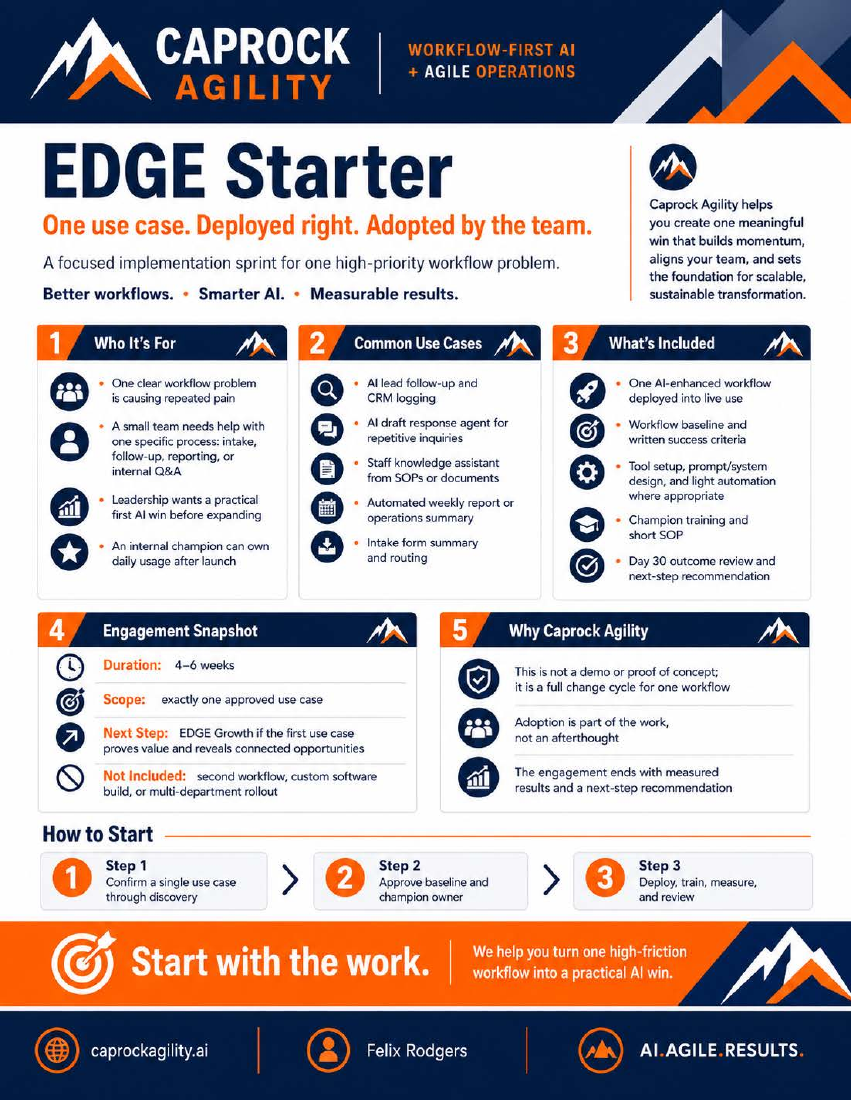
Who it’s for, the scope of one workflow, what’s included, and how to get started.
Open the animated version with playback controls, or keep the original presentation.
The film could not load. You can open or download it below.
Read the key points below for the story at your own pace.
03 / CONNECTED PROGRESS
Two to three connected workflows, delivered in one coordinated sprint.
Connect the steps that depend on one another, so an improvement in one area carries through to the next.
Your bottlenecks span a connected chain: lead intake, follow-up, CRM updates, proposals, or reporting.
A more reliable flow of work across the full chain, with fewer gaps between tools, tasks, and people.
Growth addresses the handoffs between tasks. A lead can be captured successfully while the response, CRM update, or next action still falls through. Connected workflows address those dependencies together.
Examples include customer response plus an operations report; lead intake plus a staff knowledge base and dashboard; or follow-up plus inquiry drafting and proposal generation. The right combination comes from discovery.
An 8–12 week sprint coordinates two to three workflows, with weekly 30-minute sprint reviews and team adoption support. Well-adopted workflows and measured outcomes guide further expansion.
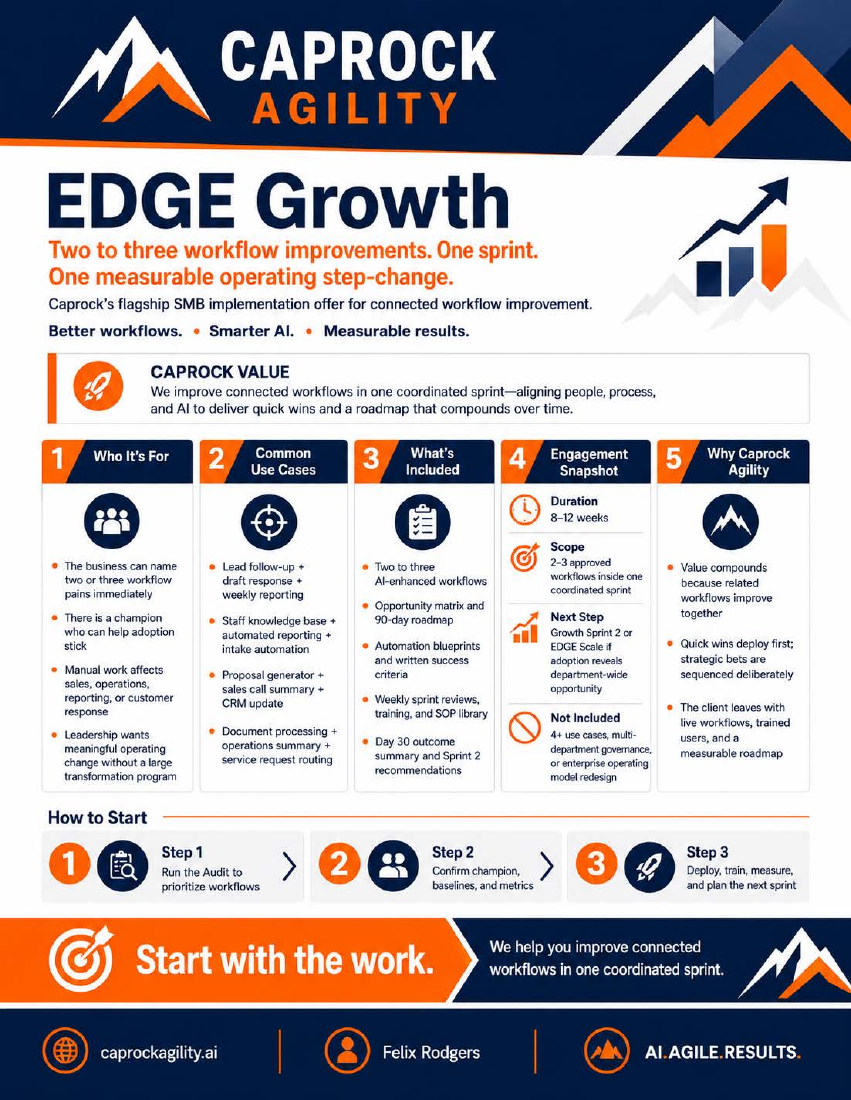
Who it’s for, the scope of two to three connected workflows, what’s included, and how to get started.
Open the animated version with playback controls, or keep the original presentation.
The film could not load. You can open or download it below.
Read the key points below for the story at your own pace.
04 / A COORDINATED UPGRADE
Four to five workflows, sequenced around the way your team works.
Bring high-volume inquiries, manual handoffs, scattered knowledge, and reporting into a coordinated operating upgrade.
Several roles in one department rely on manual workarounds, and isolated fixes are no longer enough.
A consistent operating standard across the department, with a deliberate rollout and clearer ownership.
Scale coordinates four to five workflows within a department. It addresses the points where inquiries, handoffs, knowledge, reporting, and disconnected tools create strain across multiple roles.
Quick wins can include FAQ responses, CRM logging, or ticket routing. More involved opportunities—such as proposal generation, document processing, or dashboards—are sequenced according to readiness and value.
The 10–14 week rhythm moves through discovery, design, delivery, and stabilization. Weekly reviews, role-based enablement, an SOP library, adoption tracking, and a Day 30 review help the changes take hold.
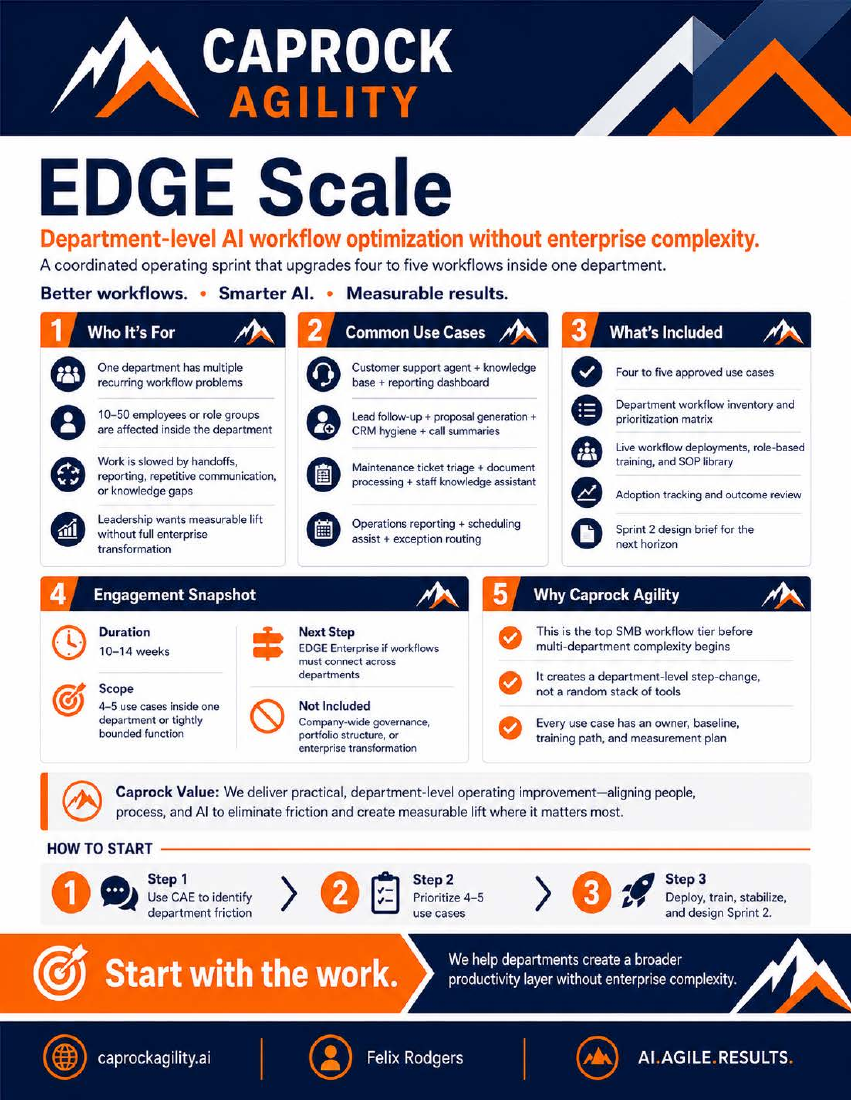
Who it’s for, the scope of four to five workflows within one department, what’s included, and how to get started.
Open the animated version with playback controls, or keep the original presentation.
Read the key points below for the story at your own pace.
05 / ENTERPRISE DELIVERY
Align leaders, clarify roles, and make delivery more predictable.
For organizations starting or stabilizing SAFe, build a working operating model for one Agile Release Train (ART) or an ART-sized business unit.
Planning, roles, dependencies, and priorities need to work together before you expand the delivery system.
A working planning and delivery rhythm with clearer roles, visible dependencies, and an informed path toward responsible AI adoption.
A dependable delivery system connects leadership priorities with the work of teams. Fragmented planning, unclear roles, weak planning discipline, and hidden dependencies make results difficult to predict.
Strategic SAFe Foundation supports one ART or an ART-sized business unit through assessment, stakeholder alignment, role and cadence guidance, prioritization, and planning. The film describes executive alignment, value-stream and ART design, one facilitated PI Planning event, role coaching, and a Measure-and-Grow baseline.
The 12–16 week engagement introduces AI literacy and readiness. Portfolio redesign, multi-ART governance, and custom production AI implementation are outside this Foundation scope. The next-step roadmap identifies where further work makes sense.
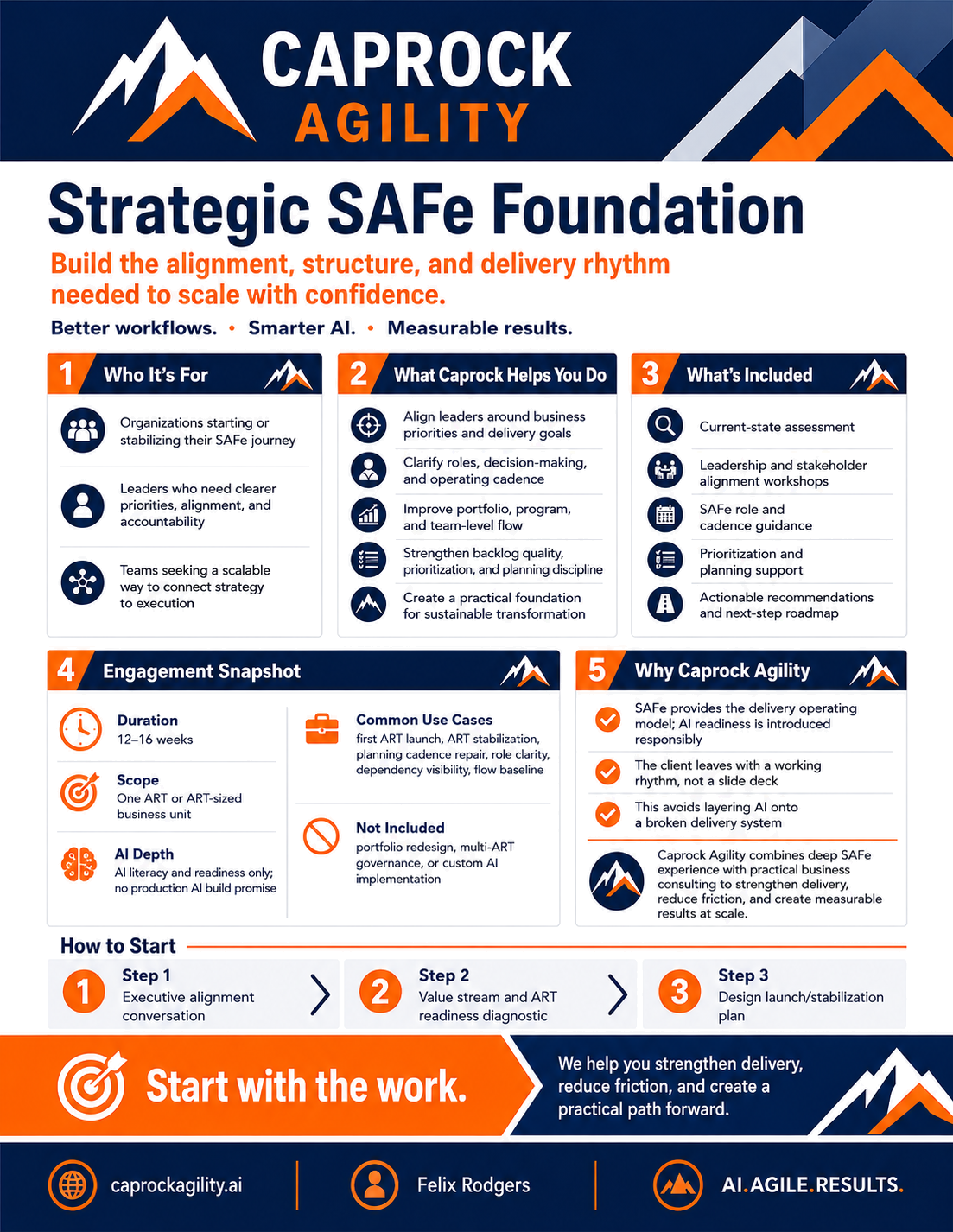
Who it’s for, what’s included, engagement scope, and how to get started.
Open the animated version with playback controls, or keep the original presentation.
A free, 30-minute Workflow Fit Call helps clarify the problem and whether there is a useful next step.